


20 Nov Business Holding: What It Is, How It Works, and When It Makes Sense to Create One
In the Spanish business environment, as in most economic contexts, holding companies have consolidated as a business management tool, asset protection mechanism and tax optimization instrument, being an organizational model widely adopted globally.
From Navarro Llima Abogados, as experts in corporate law and in planning national and cross-border corporate structures, we come to explain in simple terms what a holding company is, how it works, and when it may be advisable to transform your corporate structure.
1. WHAT IS A HOLDING COMPANY?
A holding company, also called a business holding, is a structure composed of several companies in which a parent company owns the title and control over the others, which will be the subsidiary or affiliate companies, with its main corporate purpose being the ownership of shares in the rest of the companies.
Each company in the group will continue to maintain its own legal personality and independent accounting, however, the fact that the holding exercises control allows directing, coordinating and making strategic and coordinated decisions for the entire group.
In summary:
- Holding Company (Parent): The main company, controls the others
- Subsidiary companies (Affiliates): These are the dependent companies that develop specific economic or investment activities.
As indicated, the function of the holding company is usually to hold the shares of the subsidiaries, and direct and control the latter, however sometimes it is chosen that the Holding provides certain services to its dependents, for example accounting management, brand management and its royalties and know-how at group level, or even legal or tax advice. In short, sometimes it provides services that may be common for the group’s subsidiary companies.
When it exercises no other activity than management we will speak of a pure holding, and when it also provides certain services we will speak of a mixed holding, each one has its advantages in its own sphere, so it will be necessary to attend to the specific needs of each situation to opt for one of them.
An important note is that for the creation or restructuring of the group into the Holding-Subsidiaries form we can accommodate ourselves to the special tax regime for corporate restructuring, regulated in Chapter VII of Title VII of the Corporate Income Tax Law.
Said regime will allow the restructuring to be carried out without immediate tax cost provided that the operation is carried out for valid economic reasons and the pertinent requirements are met. (An example of an operation that can be assigned to this regime is the exchange of securities)
2. HOW A HOLDING COMPANY WORKS
To understand how a holding company works we are going to propose an example of a classic structure. We will have 4 companies:
- Company 1 S.L. – is the holding company dedicated to directing the rest.
- AAA S.L. – is an operating company dedicated to selling products.
- BBB S.L. – is a company that has a real estate portfolio.
- CCC S.L. – is a company providing Administrative services. Accounting, etc.
These 4 companies would be structured in the following way

3. FUNCTIONS AND INTERDEPENDENCE OF THE DIFFERENT COMPANIES
AAA through the sale of manufactured products, functions as the operating company.
BBB with its real estate portfolio manages them and can potentially rent them to AAA and CCC.
CCC provides accounting services to AAA, BBB and Company 1 S.L.
The scheme would be as follows:
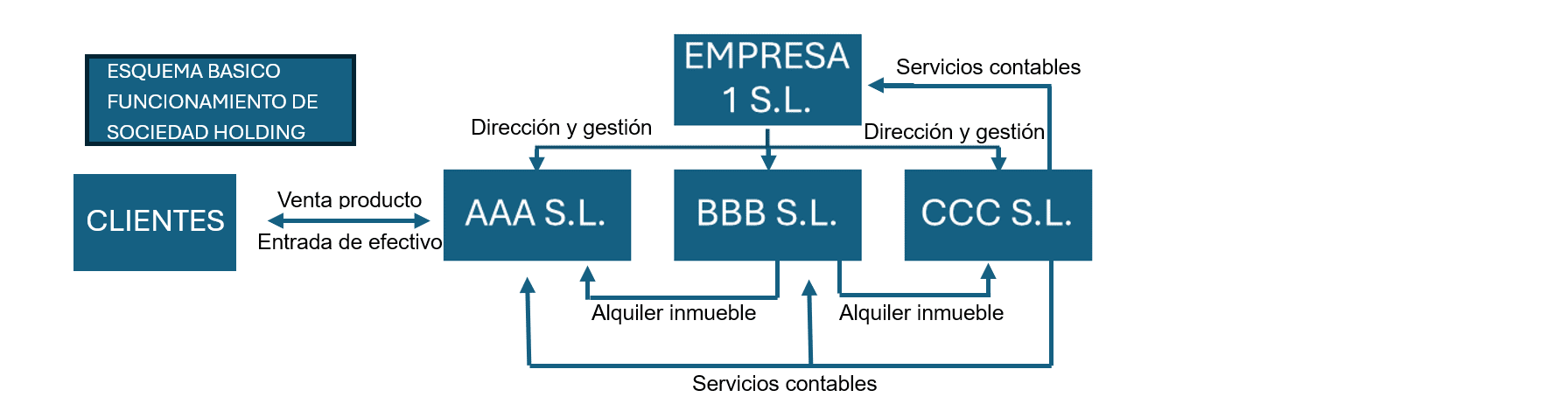
Of course, if CCC has sufficient capacity, and BBB a broader real estate portfolio, both can, in the exercise of their corporate purpose, provide services to third parties, which would make them also contribute directly to the cash inflow to the group.
If the group is well structured and legal requirements are met, the holding companies will be able to benefit from a 95% exemption on the distribution of dividends received from subsidiary companies, which will also not be subject to withholding, thus facilitating liquidity mobility to the parent company.
According to article 21 of the Corporate Income Tax Law, dividends and capital gains obtained by a parent company from its subsidiaries are 95% exempt, provided that the participation is at least 5% and is maintained for one year.
In this entire structure, the subsidiary companies relate to each other through linked contract structures, each maintaining its legal independence.
This type of structure is not valid for any type of business, but in certain cases where there is a generation of cash flow and profits that may exceed the needs of both the operating company and the consumption needs of its partners, it allows the investment of said amounts or their use as investment in other business projects with significant tax savings.
We take care of it for you
At Navarro Llima Abogados we are experts in Corporate Law and we are here to help you, so we invite you, in case doubts have arisen and you need advice, to contact us through info@navarrollimaabogados.com.
Additionally, if you wish to receive reliable legal information on various topics related to commercial law, you can subscribe to our newsletter.
Article written by the Corporate Law department of Navarro Llima Abogados, experts in corporate restructuring and tax planning.
No Comments