


16 Jan BUSINESS HOLDING II: CASH FLOW MANAGEMENT AND OPERATIONAL ADVANTAGES
In the Spanish business environment, as in most developed economies, holding companies have become a well-established tool for corporate management, asset protection and tax optimisation. This represents an organisational model that has been widely adopted on a global scale.
In the first part of this BLOG series: HOLDING EMPRESARIAL: QUE ES, COMO FUNCIONA Y CUANDO TE CONVIENE CREAR UNO we have outlined the fundamental principles of establishing a holding company, including its function and optimal timing.
On this occasion, we will be focusing on other key aspects of parent or holding companies, in
particular their financing mechanisms and the main operational advantages.
1. Financing and Cash Flows within the Group
In addition to the fact that cash will circulate between the different group companies through intercompany agreements, this is sometimes not sufficient, as illustrated by the following example.
Let us assume that, in the previous example, company AAA is in need of a new industrial facility. However, in order to acquire it through BBB and maintain asset segregation, the latter will require additional liquidity.
Concurrently, company CCC is planning to start providing accounting services to third parties, a move which will also require the allocation of funding.
In such a scenario, the implementation of a holding structure can offer significant advantages. Should the parent company have accumulated funds as a result of dividends distributed by its subsidiaries, the following options are available: i) A capital investment may be made in company BBB, thereby ensuring sufficient liquidity to acquire the new property.; and ii) For company CCC, given the nature of the intended operation, financing may be arranged through a loan granted by a related entity.
All such transactions must, of course, be carried out in accordance with the Spanish related- party transactions regime set out in Article 18 of the Ley del Impuesto de Sociedades.
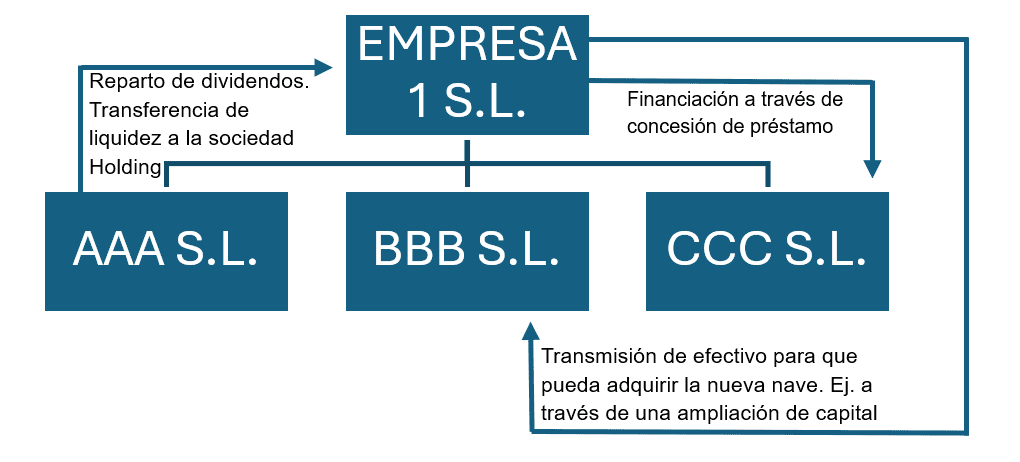
Las operaciones se realizarán conforme al régimen de operaciones vinculadas del artículo 18 de la Ley del Impuesto de Sociedades.
2 .Benefits of establishing a holding company
The following are some of the key benefits of structuring a group in this way:
- The 95% exemption regime on dividends distributed by subsidiaries to the holding company significantly facilitates the movement of cash within the group.
- The company’s assets must be segregated and protected. In the above example, company BBB holds the real estate and industrial facilities, thereby shielding them from the risks assumed by the manufacturing company and the accounting services company. This structure also allows, where appropriate, for a more tax efficient disposal of assets.
- A bespoke corporate structure is in place for each line of business, facilitating streamlined management of internal operations in line with the corporate purpose of each entity.
- Intra-group financing is available without the need to resort to third parties, with the ability to structure flexible interest loans, shareholder loans, participating loans or even asset swaps in a straightforward manner.
- Centralised management and strategic direction at the parent company level facilitate global decision-making in the interests of the group, ensuring greater flexibility and coherence
- Facilitating succession planning. For instance, in the event of the owner of the holding company passing away, their shares in the parent company would be inherited by their heirs, rather than the shares in each subsidiary being fragmented. This approach is a highly effective means of preserving the unity of the group and minimising the risk of disputes among heirs.

There are, of course, many other advantages and beneficial legal applications, but listing them all would require a separate article dedicated exclusively to everything a holding structure can offer.
3. How we can help.
The use of holding companies has become a key tool for optimising the structure of business
groups. When implemented effectively, they facilitate centralised management, effective
family succession planning and a robust legal framework for the different business lines.
However, as previously mentioned, there is no one-size-fits-all solution. It is important to note that each company has its own unique tax, asset and operational circumstances, as well as different objectives and constraints. This underscores the crucial role of specialised legal expertise in such situations.
At Navarro Llima Abogados, we specialise in Corporate Law and are here to assist you. Should you have any questions or require tailored advice, please do not hesitate to contact us at info@navarrollimaabogados.com.
You may also subscribe to our newsletter if you wish to receive reliable legal updates on a wide
range of corporate and commercial law topics.
This article has been prepared by the Corporate Law Department of Navarro Lima Abogados, specialists in corporate restructurings and tax planning.
No Comments