

29 Sep Corporate Compliance for Spanish Subsidiaries: Navarro Llima Abogados
Our experience at Navarro Llima Abogados advising foreign groups has shown us, more often than we would like, how Spanish subsidiaries of foreign groups can end up in breach of their corporate obligations without realising it. It is common for a subsidiary to invoice as normal, pay its taxes and its staff’s salaries and yet, all the while, accumulate corporate compliance failures that nobody notices. We are not referring to tax or employment obligations, which tend to be well looked after, but to those that stem from the company’s very status as a company: filing its accounts, keeping its statutory books, keeping its Commercial Registry entries up to date and documenting its transactions with the parent company.
Admittedly, these obligations are less visible day to day, but failing to comply with them can bring the subsidiary’s operations to a standstill and, in some cases, shift liability onto its directors or even onto the parent company itself. In this article, we set out some of the most common problems, their consequences and how we can help.
Four compliance failures with serious consequences
Annual accounts not filed
Under Spanish law, the general meeting must approve the annual accounts within six months of the financial year-end (Article 164 of the Spanish Companies Act, Ley de Sociedades de Capital or “LSC”), and the directors must file them with the Commercial Registry within one month of their approval (Article 279 LSC). If this is not done:
| Closure of the company’s registry sheet | No corporate resolution may be registered, save for a limited number of exceptions such as the removal of directors or the revocation of powers of attorney (Article 282 LSC and Article 378 of the Commercial Registry Regulations). |
| Fines | Fines ranging from €1,200 to €60,000 may be imposed for each year of delay, rising to €300,000 where the company’s turnover exceeds €6 million (Article 283 LSC). |
| Revocation of the tax ID (NIF) | Where the accounts are not filed for four consecutive financial years (Article 147 of Royal Decree 1065/2007). Revocation prevents banks from making any debits or credits to the company’s accounts (Sixth Additional Provision of the Spanish General Tax Act). |
| Directors’ liability | Directors may be held liable for any loss caused to the company, its shareholders and its creditors (Articles 236 and 241 LSC). |
Undeclared single-member status
Most subsidiaries are wholly owned by their parent company, which makes them single-member companies under Spanish law. This status carries its own obligations, which are often overlooked:
| Declaration and registration | Single-member status must be recorded in a public deed and registered with the Commercial Registry, and the company must state that it is a single-member company in its documents, correspondence and invoices (Article 13 LSC). |
| Parent company liability | If six months pass without single-member status being registered, the parent company becomes personally, jointly, severally and without limit liable for the subsidiary’s debts incurred during that period (Article 14 LSC). |
| Sole shareholder decisions | Decisions taken by the parent company as sole shareholder exercise the powers of the general meeting and must be recorded in minutes signed by the parent company or its representative (Article 15 LSC). Without those minutes, there is no way of evidencing the decisions to third parties. |
Undocumented related-party transactions
Transactions between the subsidiary and its parent company (management services, loans, royalties or sales of goods) must be valued at arm’s length (Article 18 of the Spanish Corporate Income Tax Act, “LIS”) and documented in accordance with Articles 13 to 16 of the Corporate Income Tax Regulations. They must also be reported on Form 232 where they exceed certain thresholds. Where documentation is missing or insufficient:
| Tax adjustments | The Spanish Tax Agency may adjust the value of the transactions and claim the resulting tax together with late-payment interest. |
| Specific penalties | Fines of €1,000 per item of data and €10,000 per set of data omitted or false, or of 15% of the value adjustments made (Article 18.13 LIS). |
| Non-deductible expenses | Payments such as management fees may be disallowed as a deductible expense if the actual provision of the service cannot be evidenced. |
Expired directorships and unrevoked powers of attorney
In private limited companies (SL), directors hold office indefinitely unless the articles of association set a fixed term; in public limited companies (SA), the maximum term is six years (Article 221 LSC). Once the term ends, the appointment expires (Article 222 LSC). The most common problems are:
| Expired directorship | On paper, the company is left without a governing body, which makes it difficult to formalise resolutions until the situation has been regularised. |
| Unregistered changes | Appointments and removals must be submitted for registration within ten days of acceptance (Article 215 LSC). Anything not recorded in the Commercial Registry cannot be relied upon against third parties acting in good faith (Article 21 of the Spanish Commercial Code), and anyone running the company without a valid appointment may be held liable as a de facto director (Article 236.3 LSC). |
| Unrevoked powers of attorney | Former managers may continue to bind the company vis-à-vis third parties until the revocation of their powers has been registered. |
Why does it go unnoticed?
If the consequences are so serious, one may well ask how these failures can be so common. In our experience, the answer almost always lies in a combination of three factors:
- The parent company assumes it is all taken care of. The subsidiary usually has an adviser in Spain who handles its accounting and payroll. It is easy to assume that this adviser also deals with the company’s other obligations, even though this is rarely the case.
- The subsidiary does not give it any thought. The subsidiary’s management tends to focus on the business and may not even have the authority to deal with some of these obligations. On top of that, it usually lacks ongoing legal support.
- There are no warning signs. Unlike unpaid tax, which is usually claimed relatively quickly, a corporate compliance failure produces no immediate symptoms. The failure to file annual accounts, for instance, builds up silently until something brings it to light.
When the problem comes to light
That “something” is usually one of the following triggers:
- A tax audit. For example, when the Spanish Tax Agency adjusts transactions that the subsidiary has been carrying out with its parent company without documenting them properly. (Other triggers may still leave some room to mitigate the consequences, but this is the most dangerous one: failing to document the transactions and put everything in order before the audit begins can leave the company in a considerably weaker legal position.)
- A routine corporate transaction. When a director is replaced, it emerges that the directorship has expired; or, when a capital increase charged to reserves is approved, it turns out that the company’s registry sheet has been closed.
- An employment or commercial dispute. In any legal dispute, the opposing party’s lawyers may look into the group’s corporate compliance, and any failures they find could make it easier for several group companies to be held jointly and severally liable or, at the very least, weaken the subsidiary’s position in the dispute.
- A change of management. When new management takes over the subsidiary, they cannot find the documentation and do not know what decisions have been taken or why, which undermines the company’s operations and efficiency.
Given the moments at which these problems tend to surface, it is clear that failing to meet the obligations described above (among others) puts the subsidiary at a real competitive disadvantage, owing to the operational and financial costs it may entail.
How we can help
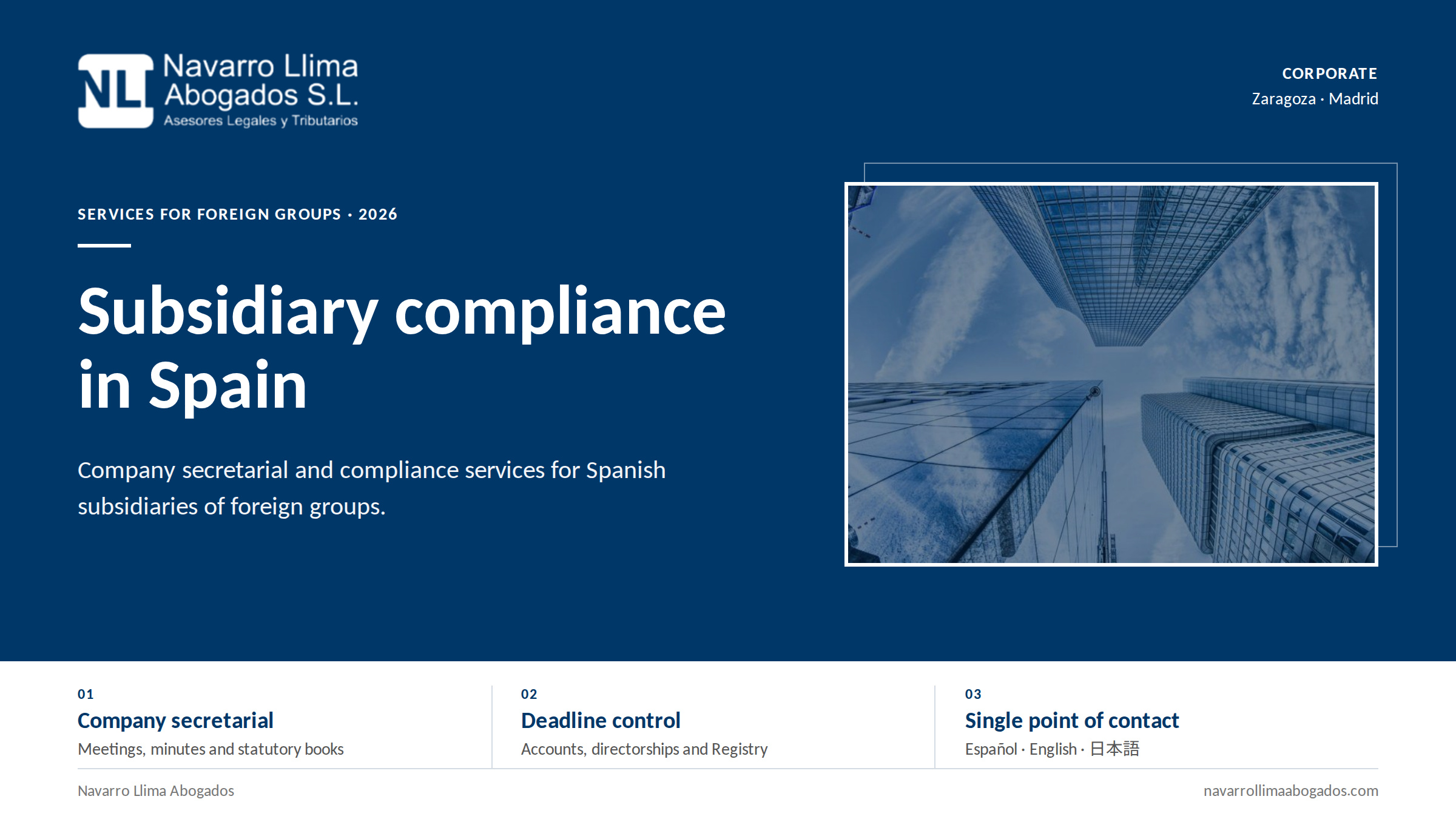
At Navarro Llima Abogados, we provide company secretarial and corporate compliance services to Spanish subsidiaries of foreign groups. Our role is to bring the subsidiary up to date and keep it compliant on an ongoing basis, reporting regularly to the parent company and thereby relieving it of one of its concerns.
In practice, our work includes, among other things:
- Corporate housekeeping: general meetings, minutes, and the keeping and annual legalisation of the company’s statutory books.
- Deadlines: an annual compliance calendar with advance reminders, so that accounts are filed on time and directorships are renewed before they expire.
- The Commercial Registry: registration of any change of directors, attorneys-in-fact, registered office or single-member status, and keeping beneficial ownership information up to date.
- Official notifications: monitoring the company’s electronic notification mailbox and forwarding anything relevant without delay.
- Dealings with the parent company: reviewing intra-group agreements and related-party transaction documentation.
We do not replace the subsidiary’s accounting, tax or employment advisers: we cover what normally falls outside their remit. Where the subsidiary needs it, we can take on other services under a separate engagement or work alongside its existing providers.
All of this is handled by a single dedicated lawyer who knows the subsidiary and its history, reports regularly to the parent company and can deal with it directly in Spanish, English or Japanese.
With more than twenty-five years’ experience supporting foreign groups in Spain, Navarro Llima Abogados can review the current position of your subsidiary and propose a plan to bring it up to date. Contact us at info@navarrollimaabogados.com.
No Comments