

20 Nov Intercompany Loans to Spanish Companies in Your Group: How to Lend Money Without Problems
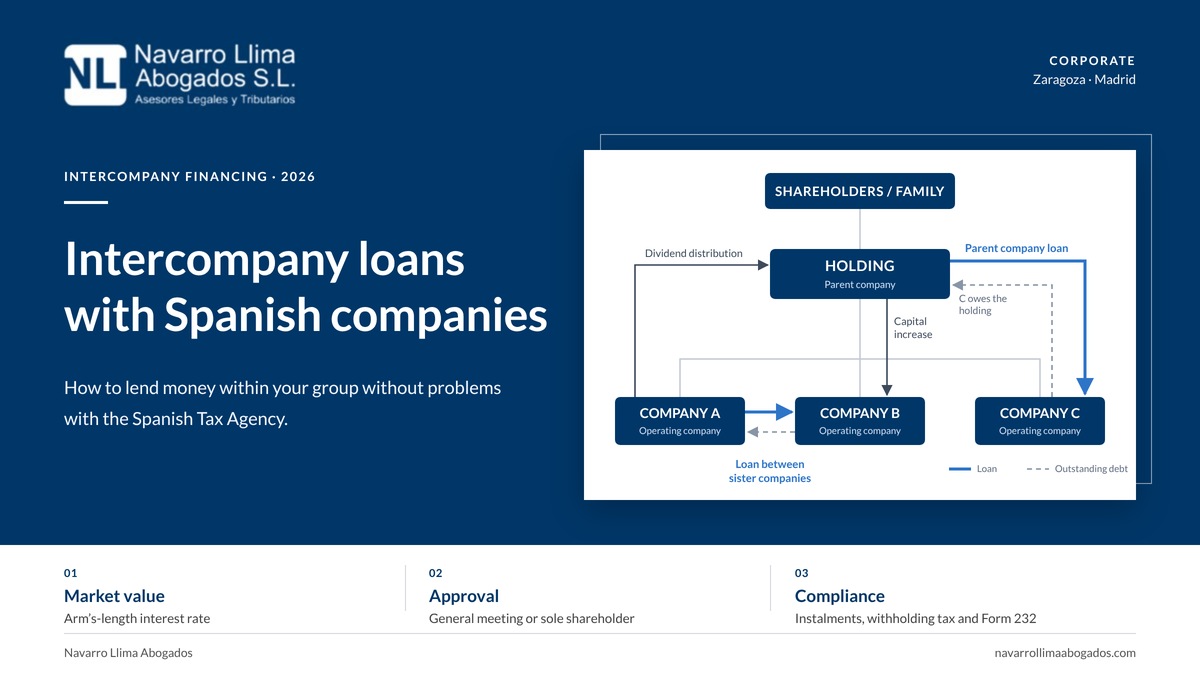
When one company in your group has cash available and your Spanish subsidiary needs liquidity, or vice versa, the logical thing is for them to “help” each other. This has some clear benefits, such as speed (it saves a good deal of bank paperwork) and the fact that the money stays within the group. However, it also has its drawbacks, as this financing is often provided without a contract, without interest and without a repayment schedule, which is precisely what the Spanish Tax Agency will look at, given that the transaction takes place between related companies.
In this article, we explain what intercompany loans in Spain are, when it is advisable to use them and when it is not, and other related aspects, with a particular focus on foreign groups with a subsidiary in Spain.
What is an intercompany loan and what is it for?
Essentially, it is an ordinary loan, with the particularity that the lender and the borrower belong to the same group of companies.
By way of example, consider a foreign group that manufactures machinery in its home country and has a subsidiary in Spain that leases that machinery to Spanish customers. Suppose the Spanish subsidiary needs additional liquidity to invest in its business and, rather than turning to a bank, the two companies sign a loan agreement under which the parent company lends it the necessary amount.
Beyond this example, intercompany financing can be very useful at many different times, for instance to ease cash-flow pressures, to supplement bank financing or to get new companies off the ground when they struggle to obtain bank financing, as is often the case with a newly incorporated Spanish subsidiary. It is also a way of putting idle liquidity to work. If one company has surplus funds that it does not need in the short or medium term, it can lend them to another that does, so that the lender earns interest and the money remains within the group.
What matters in this arrangement, therefore, is not the movement of money as such, but the relationship between lender and borrower, the situation of both companies and other aspects such as how quickly the funds are needed. Because of the advantages this arrangement can offer, and the “fraudulent” uses to which it could be put, intercompany financing (and related-party transactions in general) is subject to a series of requirements under Spanish law, and must be handled with care.
When should an intercompany loan be signed?
If a group company is going to lend money to your Spanish subsidiary, or vice versa, and expects to get it back, the correct approach is to sign the loan agreement before making the transfer. This makes clear from day one how much is being lent, when it will be repaid, what interest is payable and the remaining relevant terms.
However, if the purpose of the loan is not so clear, or the intention is to use this arrangement for purposes that are inconsistent with its nature, it is worth stopping to think beforehand. In particular, it should not be used to move profits with no intention of repayment, or to artificially reduce taxable profits in Spain.
Disguising something as a loan can prove costly. If the Spanish tax authorities review the alleged loan and find that there is no contract, that it was granted indefinitely or that the instalments are never paid, they may recharacterise it. This will often result in additional tax, late-payment interest and even penalties.
Market value
As mentioned above, because this is a transaction between related companies, it must be carried out at market value. This is laid down in Article 18 of the Spanish Corporate Income Tax Act. It may seem that this only concerns the interest rate, but the requirement is also indirectly affected by the term, the amount, the situation, the purpose…
It is therefore not advisable to sign an interest-free loan or simply to apply the Spanish statutory interest rate (interés legal del dinero). The most appropriate approach is to use the comparable uncontrolled price method, which consists of taking as a reference the rate of other loans between independent parties and adjusting it to the circumstances of the transaction.
It is also important to record the circumstances that led to the adjustment, for example the borrower’s business outlook, the lender’s opportunity cost, market returns and the risk of default.
Logically, the more complex the transaction, the greater the justification required. This is particularly true of cross-border loans, where the lender is a foreign group company.
Approval of the transaction
As this is a transaction between related entities, it is important to be able to show that it has been approved by the competent body of each company and that it serves the interests of that company, not merely those of the group. On the Spanish side, depending on the case, the decision will fall to the management body or to the general meeting.
As a general recommendation, we advise that the loan be approved by resolution of the general meeting or, where applicable, by decision of the sole shareholder, which in many Spanish subsidiaries is the foreign parent company itself. Even where the law does not require it, this records that all shareholders were aware of the transaction and agreed to it, which reduces the risk of later disputes. The approval must be recorded in writing and must be dated no later than the date of the agreement.
Signing is not the last step
There is no point in drafting a good agreement and calculating a correct interest rate if it is not then complied with. Instalments and interest must be paid on the agreed dates, by bank transfer and with a reference identifying the agreement, not through informal set-offs. A loan that is never repaid ends up being the best evidence that it was never a loan. There are also certain formal obligations, such as proving the date of signature, withholding tax on the interest or filing, where applicable, the related-party transactions return, which we will address in a future article. Where the lender is a foreign company, the withholding tax position should be reviewed on a case-by-case basis.
In addition, intercompany financing granted by foreign companies to Spanish companies must, in certain cases, be reported as foreign investment, as we explained in our article on the information obligations of foreign investors in Spain.
Our experience
At Navarro Llima Abogados, we have extensive experience in preparing, reviewing and structuring intercompany transactions of all kinds, including those between foreign parent companies and their Spanish subsidiaries. We advise our clients on these transactions every day and work with them to ensure that they are properly put in place from the outset and that they can have peace of mind, something that is increasingly relevant given the growing prominence of holding structures and international groups in the Spanish economy. We also provide a corporate compliance service for Spanish subsidiaries, which includes documenting their transactions with the parent company.
Our managing partner, Jaime J. Navarro, has extensive experience in commercial and company law and in advising groups of companies, and our team can assist you in Spanish, English or Japanese.
If you have any questions about financing between your group companies in Spain, or would like our assistance, please do not hesitate to contact us at info@navarrollimaabogados.com.
También le puede interesar:

The supply contract

ARTICLE BY JAIME J NAVARRO IN THE SEPTEMBER ISSUE OF "BUSINESS WORLD" INTERNATIONAL MAGAZINE

Data Center Regulation in Spain: The New Draft Rules

Practical advice on the termination of a distribution contract

No Comments