


08 May Types of Corporate Division in Spain: Full, Partial and Segregation
General overview
A corporate division consists of the universal transfer, in a single act, of all or part of a company’s assets. In other words, a block of assets can be separated from one company in order to be transferred as a whole to a second company.
We must pay particular attention to the continuity of the shareholder’s status: whoever was a shareholder of the entity whose assets are divided will become a shareholder of the corresponding proportion in line with how the operation has been structured (although this principle has certain exceptions, it is necessary to refer to it in order to understand the essential features of the figure).
Given its versatility, the corporate division in its various modalities allows for the adaptation of countless structural business situations, enabling the internal structure of companies and groups to be tailored to the requirements that may arise from business growth, succession planning, or asset reorganisation.
Types of corporate division
Essentially, and notwithstanding the existence of other related modalities, the basic types of corporate division are full division, partial division, and segregation.
1) Full division
The full division constitutes the modality with the broadest scope among corporate division operations. Pursuant to Article 59 of Royal Decree-Law 5/2023 and Article 76.2.1.º a) of the Corporate Income Tax Act (LIS), it consists of the extinction of a company, with division of the entirety of its assets into two or more parts, each of which is transferred as a whole by universal succession to one or more companies (whether newly incorporated or already existing).
The divided company is dissolved without liquidation, and the shareholders receive shares or holdings in the beneficiary companies in proportion to their previous participation. They may additionally receive a cash compensation not exceeding 10% of the nominal value.
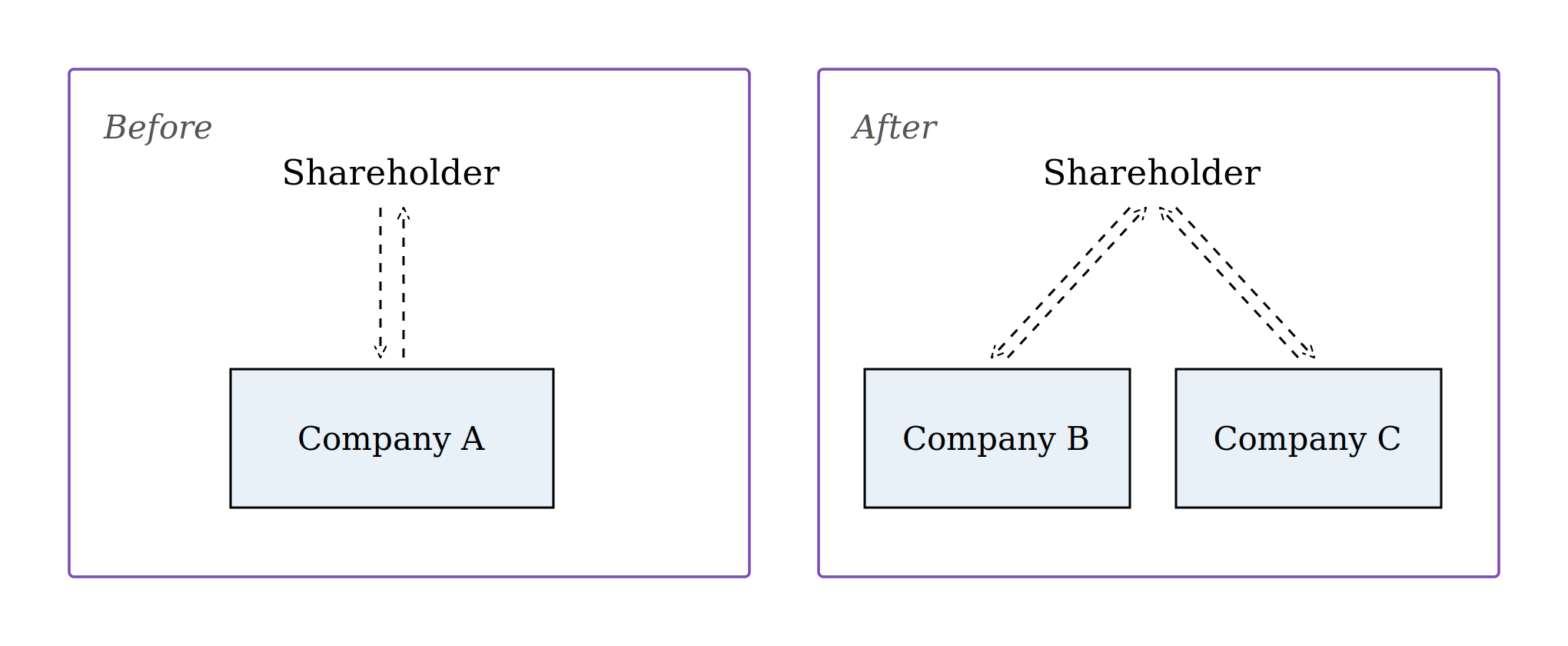
From a tax perspective, it is worth noting a relevant difference compared to the partial division: when the allocation to shareholders is proportional, the tax neutrality regime of Chapter VII of Title VII of the LIS does not require the divided assets to constitute business units (Article 76.2.2.º LIS). Only when the allocation is non-proportional (asymmetric) does the requirement of business unit reactivate. This makes the proportional full division a particularly flexible route for reorganising assets when it is not possible to establish the existence of differentiated autonomous economic units.
2) Partial division
The partial division, regulated in Article 60 of Royal Decree-Law 5/2023 and in Article 76.2.1.º b) LIS, is characterised by the survival of the original company. The latter segregates one or more parts of its assets and transfers them as a whole, by universal succession, to one or more beneficiary companies —whether newly incorporated or already existing—, retaining at least one part of the assets within its own sphere. The shareholders of the divided company receive shares or holdings in the beneficiary companies in proportion to their previous participation, and the company reduces its share capital and reserves by the necessary amount. As in the full division, a cash compensation of up to 10% is permitted.
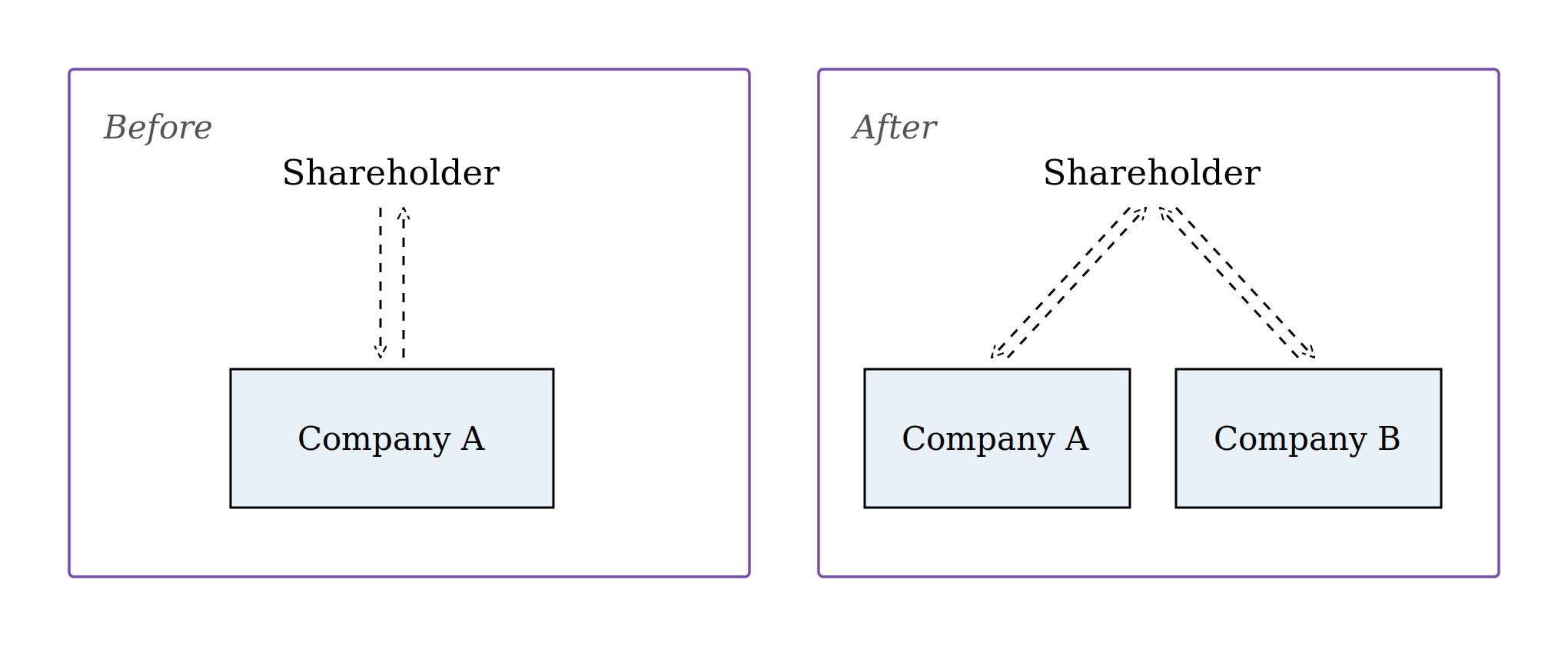
The key requirement that distinguishes this modality (and where most disputes with the tax authorities are concentrated) is that each part of the divided assets must constitute a business unit, both the part transferred and the part remaining in the divided company.
Article 76.4 LIS defines the business unit as a set of assets capable of constituting an autonomous economic unit, that is, capable of operating by its own means. The Spanish Directorate-General for Taxation (DGT) has repeatedly stressed that this autonomy must be pre-existing to the operation: the segregated assets must already have, within the transferring company, a differentiated business organisation, with its own material and human resources.
Thus, while in binding ruling V1956-25 the application of the special regime was admitted for the division of a real estate portfolio, on the basis that it had a full-time employee and dedicated resources for its management, in binding ruling V2604-21 it was denied because it concerned a mere isolated asset without prior differentiated organisation.
3) Segregation
The segregation, regulated in Article 61 of Royal Decree-Law 5/2023, is characterised by the transfer as a whole, by universal succession, of one or more parts of a company’s assets —each of which must constitute an economic unit— to one or more beneficiary companies. The essential difference with respect to the partial division lies in who receives the shares or holdings of the beneficiary: in segregation, they are received by the segregating company itself, not by its shareholders. The consequence is the creation of a parent-subsidiary structure instead of a structure of sister companies, without altering the composition of the shareholding or reducing the capital of the segregating company.
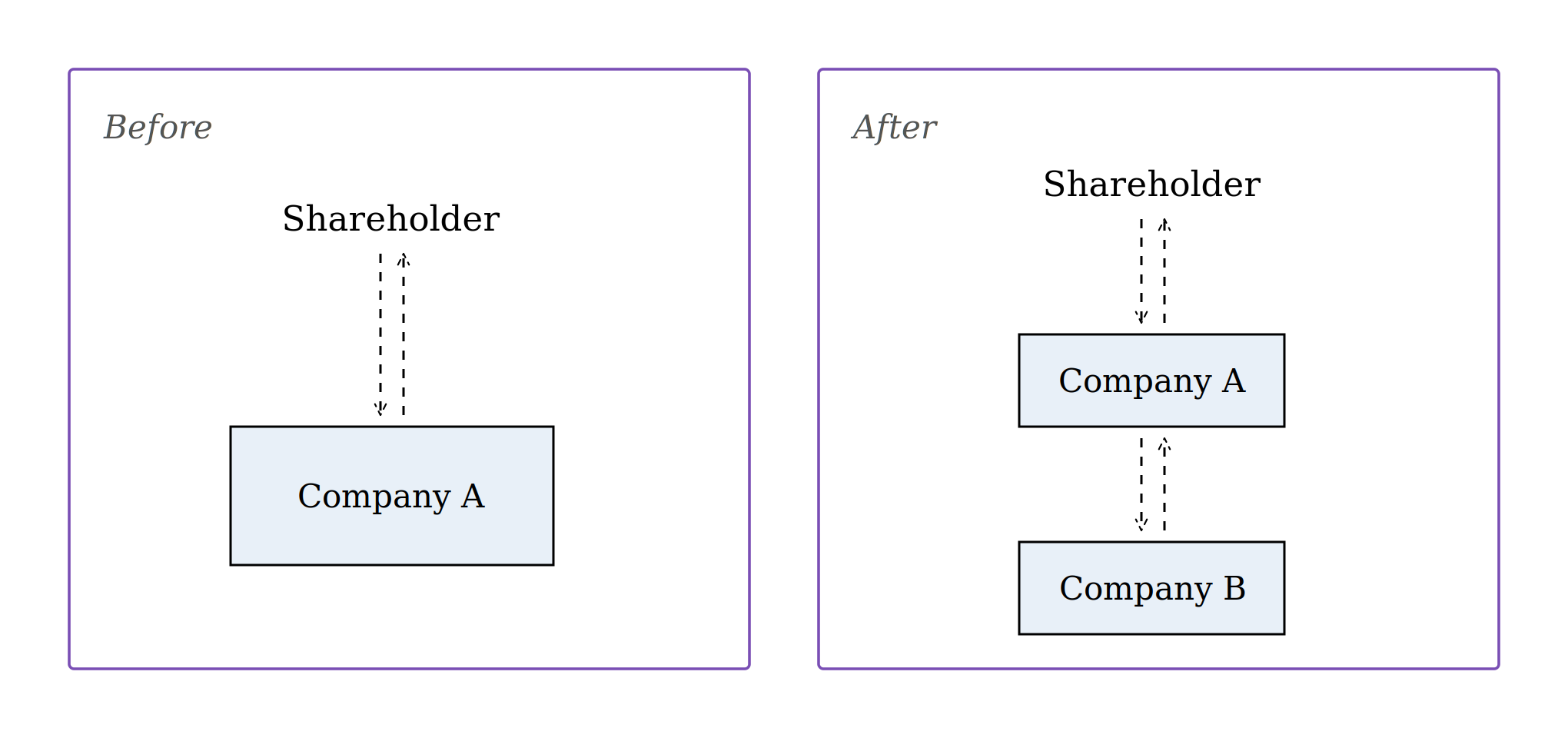
From a tax standpoint, the operation is typically channelled through the regime of non-cash contributions of business units under Article 87 LIS, with the same requirement that the contributed assets constitute a business unit within the meaning of Article 76.4 LIS.
This figure proves particularly useful in subsidiarisation operations (when an operating company wishes to transfer a division to a subsidiary without altering the ultimate ownership structure) and in planning aimed at isolating the business risk of certain activities while keeping their management under a common holding entity.
4) Other modalities
In addition to the basic typologies, reference should also be made to:
- The improper division (escisión impropia). In this modality, the parts of the assets separated from the divided company are transferred to its shareholders. That is, it is the shareholders of the divided company themselves who benefit from and absorb the relevant portion of the assets.
- The reverse division (escisión inversa). This is a full or partial division operation in which the divided company holds the entirety of the shares of the beneficiary companies. In these cases, the divided company allocates the shares of the beneficiaries as part of the divided assets, which are then attributed to the shareholders of the divided company.
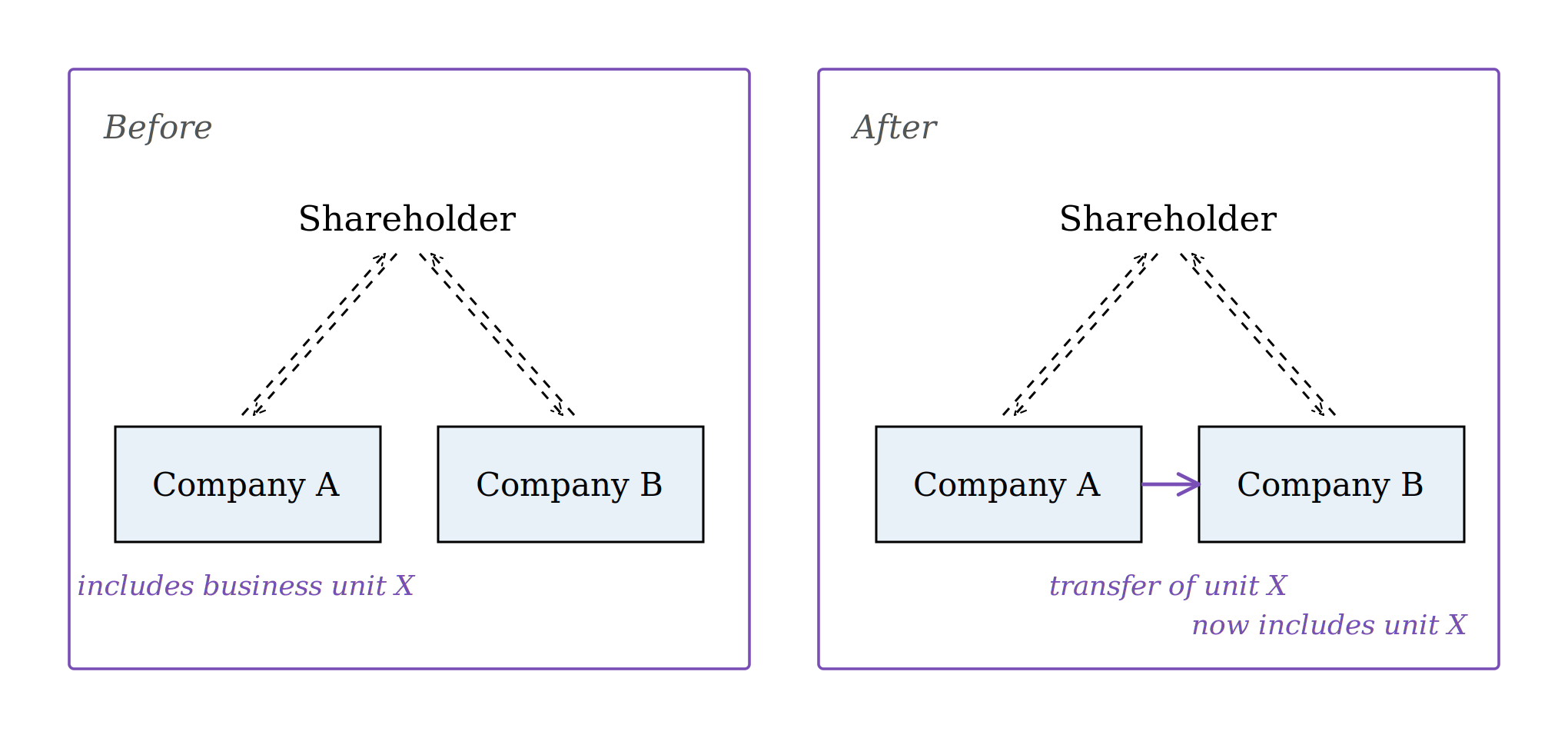
- The division of twin companies (escisión de sociedades gemelas). In this case, both the beneficiary company and the divided company are wholly held by the same shareholder; under this scenario, the beneficiary company does not need to carry out a capital increase, nor does the common shareholder receive new holdings.
How we can help
The corporate division, in its various modalities, is confirmed as a business reorganisation tool of great practical utility, capable of being adapted to a wide range of purposes: from the separation of risks between activities to succession planning, the entry of new investors, or the rationalisation of group structures. Its correct use, however, requires a careful analysis of both the corporate requirements and the tax conditions of the neutrality regime, particularly with regard to the existence of business units and the justification of valid economic motives.
At Navarro Llima Abogados we have extensive experience in the design and execution of structural modification operations, advising our clients from the planning phase through to registration, with particular attention to the documentation of the economic motives underlying the operation and to the prevention of potential contingencies in the event of administrative review.
No Comments